A personal appeal from Cape Town

I'm looking for a living kidney donor

If you've ever thought about doing something extraordinary — this might be it.

This page is purely informational. No payment or reward of any kind is offered or accepted.  ·  Skip to contact →
Simon van Gend, Cape Town

Simon van Gend, Cape Town

My name is Simon van Gend

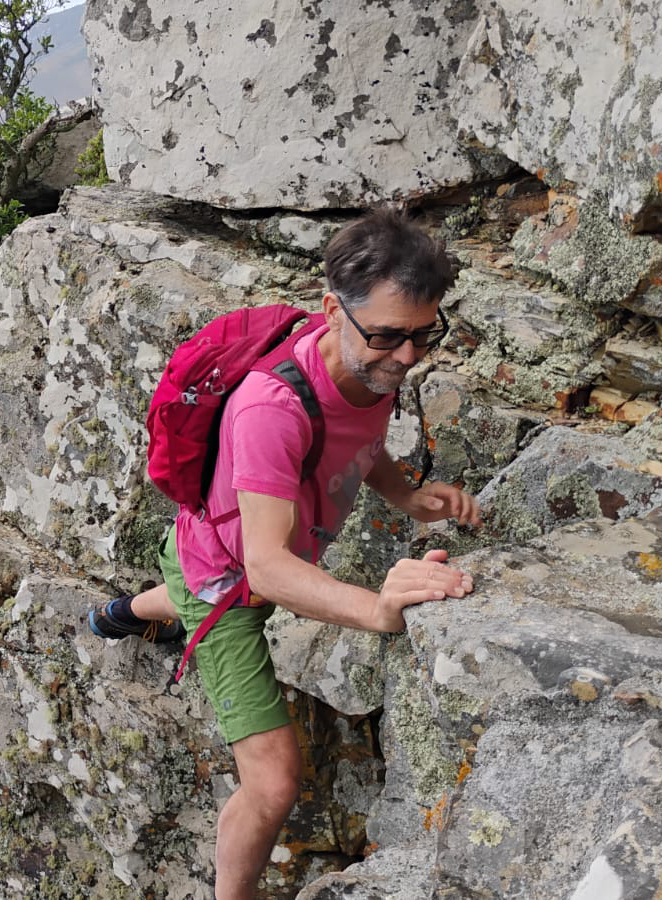
I'm 57, and I live in Observatory, Cape Town, with my girlfriend Kyle and our dog Maggie. I'm a singer-songwriter with a regularly performing band, and by day I work in publishing — doing typesetting and layout for school textbooks. I also paint watercolours, and once a week I climb Table Mountain with a group of friends.

By most measures, I'm fit and healthy. But I have advanced chronic kidney disease. My GFR — the measure of how well my kidneys are functioning — is currently 8, which is critically low. A healthy kidney functions above 90.

I've been living with this for the past couple of years, and I've reached the point where a transplant is the path forward. There is no other fix.

Finding a kidney would hopefully put the spring back in my step.

I'm not looking for sympathy — I'm looking for someone who might be willing to give me a chance at a fuller life. If that's you, or someone you know, I'd love to hear from you.

What you should know about living kidney donation

Donating a kidney is a significant decision. Here are the key facts, honestly presented.

1
Kidney is all you need

You only need one healthy kidney to live a completely normal life. Donors go on to live with the same life expectancy as non-donors.

~3–4
Weeks to recover

Most donors return to desk work within 3–4 weeks and full physical activity within 4–6 weeks. Surgery is laparoscopic (keyhole) at most centres.

100%
Voluntary & altruistic

No payment is made or accepted — it is illegal under South African law. This appeal is purely altruistic.

Free
No cost to the donor

All medical costs — evaluation, surgery, and follow-up care — are covered. You will not be out of pocket.

Could you be compatible?

The first step is blood type. My blood type is:

Simon's blood type
B+
Compatible donors
Blood type B or O
(positive or negative)

If your blood type is B or O, you could potentially be a match. Blood type is just the first filter — a full medical evaluation would follow, at no cost or obligation to you. You can stop the process at any point.

If you're unsure of your blood type, a simple blood test will tell you. Your GP can arrange it, or many pharmacies offer testing.

Don't have a compatible blood type? You may still be able to help.

There are two routes that can make donation possible even across blood type barriers:

Plasmapheresis — a medical process performed on the recipient (me, not the donor) that removes the antibodies causing the incompatibility. This can sometimes allow a transplant to go ahead between mismatched blood types. The transplant team can advise whether this is suitable in a given case.

Kidney exchange programme — South Africa has a paired kidney exchange programme, where an incompatible donor-recipient pair is matched with another pair in the same situation. Your kidney goes to someone you're compatible with, and I receive a kidney from someone compatible with me. Everyone benefits, and your gift is just as real. The transplant team can provide full details.

So even if your blood type rules out a direct donation, please don't let that stop you from getting in touch — it's worth exploring.

Important note: South African law (National Health Act 61 of 2003) allows living kidney donation by both related and unrelated (non-family) donors. Donations by non-family members require approval from the Department of Health's advisory committee — a standard part of the process that the transplant team handles. No pre-existing relationship between donor and recipient is legally required.

Want to hear from real South African donors and recipients? Read transplant stories at TELL →  — a South African non-profit dedicated to organ donation awareness.

What happens if you're interested?

The process is careful, thorough, and at every stage — voluntary.

  1. 1

    Get in touch

    Send me an email or fill in the form below. There's no commitment involved — just a conversation. I'll answer any questions you have honestly.

  2. 2

    Initial screening

    If you'd like to proceed, you'll be referred to the transplant team. They'll do a blood type check and basic health screening — completely free of charge.

  3. 3

    Full medical & psychosocial evaluation

    If initial tests look positive, the team conducts a thorough workup — blood tests, scans, a consultation with a psychologist, and an assessment by an independent doctor whose only job is to protect your interests as a potential donor.

  4. 4

    Transplant committee approval

    For non-family donors, the case is reviewed by the transplant panel and then submitted to the Department of Health's advisory committee. The transplant team manages this process.

  5. 5

    Surgery & recovery

    If all goes ahead, surgery is typically laparoscopic — minimally invasive. Most donors are home within 2–3 days and back to normal life within a month.

You can withdraw from the process at any stage, for any reason, with no pressure and no judgment. The evaluation exists to protect you, not to recruit you.

Get in touch

Whether you want to ask a question, find out more, or think you might want to be considered as a donor — I'd welcome your message. There's no pressure and no obligation.

Or email directly: simonvangend@gmail.com

Legal note: This page is a personal appeal for a voluntary, altruistic living kidney donor. No financial reward, payment, or other incentive is offered or implied. Any donation would proceed through a registered South African transplant unit in full compliance with the National Health Act 61 of 2003 and its regulations. Trading in human organs is illegal in South Africa.